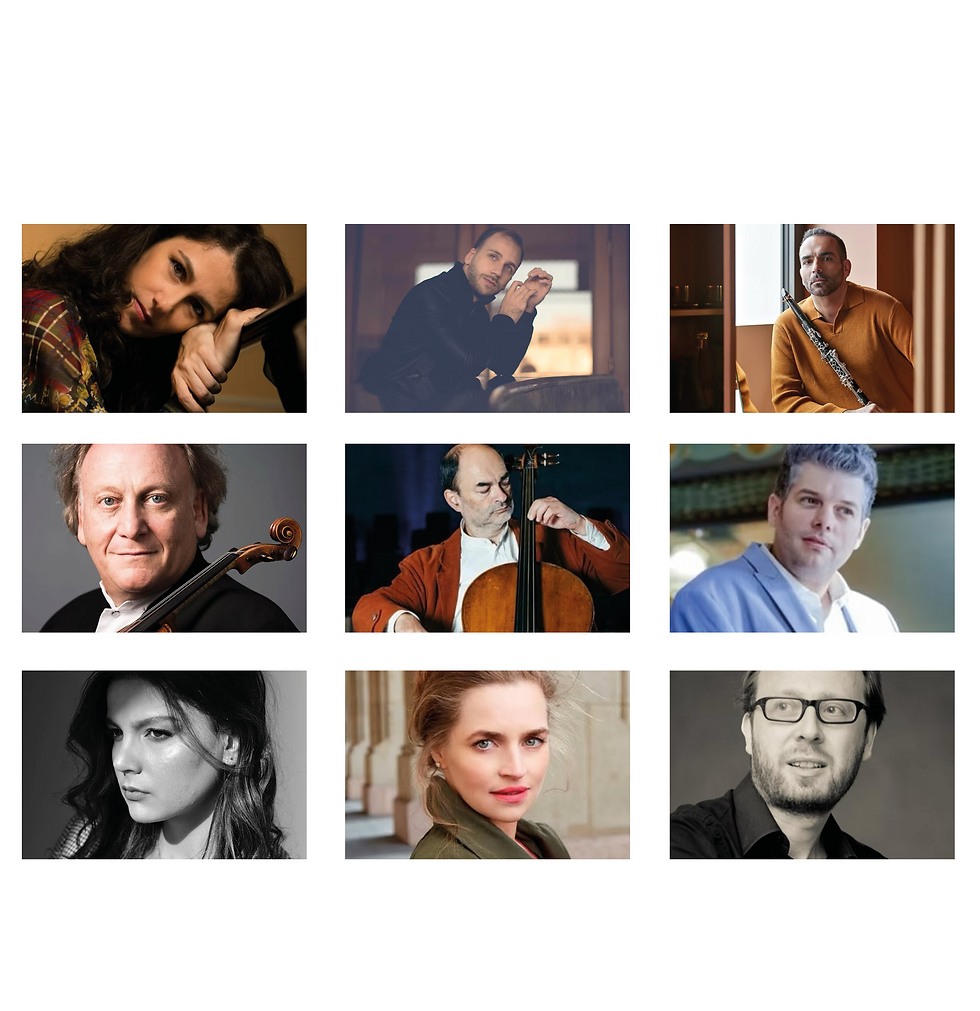
Opening Concert. Platia Diasozousa, Chora. Ammara, Coin, Genisson, Guttman, Kelemen, Kokas, Mariani, Oganyan, Prosseda
Tue 26 Aug
|Patmos - Chora, Panagia Diasozousa, 9PM
Mozart (1756-1791): Piano Quartet in G minor Kelemen, Kokas, Coin, Prosseda Ravel (1875-1937): Tzigane Kelemen, Ammara Bloch: Vidui, Simchas Torah Guttman, Mariani Gershwin (1898-1937): Rhapsody in Blue Genisson, Oganyan Glick (1934-2002): The Klezmer Wedding Guttman, Genisson, Prosseda
Time & Location
26 Aug 2025, 21:00
Patmos - Chora, Panagia Diasozousa, 9PM, Patmos 855 00, Grecia
About the event
Wolfgang Amadeus Mozart
(1756-1791)
Piano Quartet in G minor, K 478
Barnabas Kelemen, violin
Katalin Kokas, viola
Christophe Coin, cello
Roberto Prosseda, piano
Maurice Ravel
(1875-1937)
Tzigane in D, M 76
Barnabas Kelemen, violin
Alessandra Ammara, piano
George Gershwin
(1898-1937)
Rhapsody in Blue
Pierre Genisson, clarinet
Maya Oganyan, piano
Ernest Bloch
(1880-1954)
From Baal Shem: Vidui - Simchas Torah
Michael Guttman, violin
Andrea Mariani, piano
Srul Irving Glick
(1934-2002)
The Klezmer wedding
Michael Guttman, violin
Pierre Genisson, clarinet
Roberto Prosseda, piano
This opening concert will feature an engaging selection of chamber works in a programme that, beginning with Mozart and passing through Ravel and Gershwin, will culminate in a set of pieces from the klezmer tradition – a form of Jewish music originating in Eastern Europe, which will be examined in greater detail below. The festival will be inaugurated with the Piano Quartet in G major K. 478, by Wolfgang Amadeus Mozart (1756-1791), composed in October 1785. This work, by virtue of its stylistic and technical qualities, represented a genuine rupture within the world of chamber music, as Mozart sought to elevate the genre to a higher artistic level. Until that point, chamber compositions were primarily intended for an amateur context; however, the technical demands of this piece raised the bar significantly, prompting a change in marketing strategy following its publication in the winter of 1785-1786. As noted by Georg Nikolaus Nissen (1761-1826), Mozart’s first biographer, this quartet was originally intended as the first of a set of three, but, given the work’s complexity for the Viennese amateur public, both the composer and the publisher Hoffmeister decided to terminate the contract, releasing the piece as a single publication. This episode is but one symptom of the novelty and complexity of the work, in which the instrumental writing reveals a far more intricate dialectic between the parts – more independent than in earlier chamber literature – and approaches, with striking proximity, the genre Mozart was concurrently bringing to maturity: the piano concerto. In a context imbued with dramatic intensity, the keyboard part assumes a distinctly soloistic and virtuosic role, while the strings, far from serving as timid accompanists, engage in an active dialogue, breaking through the conventions of earlier chamber music and opening new compositional possibilities.
Almost one hundred and forty years later, Maurice Ravel (1875-1937) composed Tzigane for violin and piano in D major, Op. 76, subtitled Rapsodie de Concert. In a period marked by the continuous expansion of compositional resources – in terms of both instrumentation and orchestration – Ravel specified “Violon et Piano (ou Luthéal)” in the original score, indicating an optional use of the luthéal, a piano modification that expanded the instrument’s timbral palette through an additional mechanism of stops and levers. This system allowed various objects to be placed on the piano strings, producing sonorities akin to those of the cimbalom (also known as the Hungarian dulcimer), a struck or plucked string instrument. This “local colour” from Central and Eastern Europe is also reflected in the title, as tzigane derives from the French term gitan (also found as tsigane or tzigane), which in Ravel’s time referred not to a specific population or culture, but rather to a form of popular musical exoticism comparable, for example, to the Janissary style in certain Mozart compositions. Structured as a single movement, the 1922-24 version for violin and piano was followed almost immediately by an orchestral arrangement.
Also from 1924 is George Gershwin’s (1898-1937) celebrated Rhapsody in Blue, initially conceived for two pianos but ultimately orchestrated for piano and Big Band. Even in its instrumentation, the work reveals a fusion of genres, reflecting Gershwin’s musical background and his ability to merge diverse influences drawn from so-called “art music”, jazz and blues. Composed in a remarkably short time, it was premiered on 12 February 1924 at New York’s Aeolian Hall, in the presence of such eminent figures as Leopold Stokowski, Fritz Kreisler, and Sergei Rachmaninoff. Despite its hasty completion – the piano part, played by the composer himself, was not yet fully written out – the premiere was a resounding success. Gershwin himself described the work as: “a sort of musical kaleidoscope of America, of our vast melting pot, of our unduplicated national pep, of our metropolitan madness. By the time I reached Boston I had a definite plot of the piece, as distinguished from its actual substance.”
Ernest Bloch (1880-1959) composed Baal Shem: Three Pictures of Chassidic Life in 1923 as part of his “Jewish Cycle,” a body of works inspired by Jewish liturgical and folk traditions. Of its three movements, Vidui [Contrition] and Simchas Torah [Rejoicing in the Torah] frame the cycle with contrasting spiritual states: the solemn introspection of confession and the joyous celebration of the Torah. Through modal inflections, chant-like melodies, and rhythmic vitality, Bloch fuses Western classical forms with elements drawn from Ashkenazi tradition, evoking both the inner devotion and the communal exuberance of Hasidic life.
As foreshadowed at the beginning of this brief overview, the programme will conclude with works from the klezmer tradition – an instrumental genre that developed within the Jewish communities of Eastern Europe, particularly between the eighteenth and twentieth centuries. Performed by professional musicians, klezmer music often accompanied ceremonies and festive occasions, alternating lively dance pieces with more lyrical, improvisatory melodies. Characterised by modal scales and expressively ornamented lines, klezmer reflects a composite musical identity shaped by Slavic, Romani, and Ottoman influences. After a period of decline, it underwent a vibrant revival from the 1970s onwards and today enjoys renewed vitality at the intersection of scholarly research and contemporary experimentation.
Federico Foglizzo